
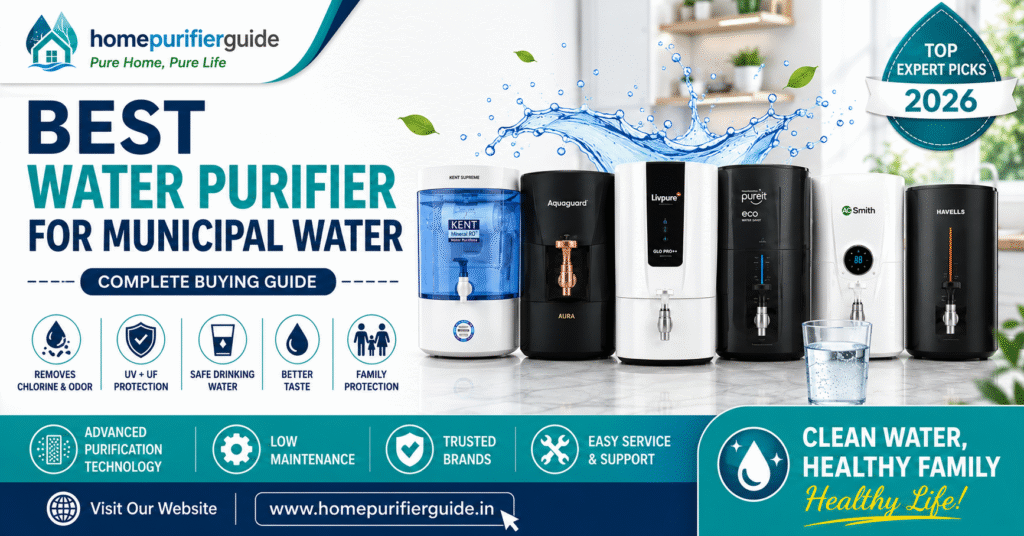
Best Water Purifier for Municipal Water in India (2026) – Complete Buying Guide
Introduction, Understanding Municipal Water, RO vs UV vs UF, Buying Guide
Access to clean drinking water is one of the most important parts of a healthy lifestyle. In India, millions of families rely on municipal water, also known as corporation water, for their daily needs. While municipal water is usually treated before reaching homes, it can still pick up impurities during storage and distribution.
Many people assume that treated municipal water is always safe to drink directly. However, the quality of water can vary depending on your city, local pipelines, storage tanks, and overall water supply system.
This is why choosing the best water purifier for municipal water is an important decision.
The good news is that not every home with municipal water needs an expensive RO water purifier. In many cases, a UV or UF water purifier may be enough. The right choice depends on your water quality, TDS level, and household needs.
In this guide, we’ll explain everything you need to know before buying a water purifier for municipal water.
What is Municipal Water?
Municipal water is the water supplied by your local government or municipal corporation. Before reaching your home, this water is generally treated at a water treatment plant to remove many impurities and disinfect it.
In India, municipal water is supplied by organizations such as:
- Delhi Jal Board (DJB)
- Bengaluru Water Supply and Sewerage Board (BWSSB)
- Chennai Metro Water
- Mumbai Municipal Corporation
- Hyderabad Metropolitan Water Supply Board
- Other city water authorities
Because municipal water is treated before distribution, it is often cleaner than untreated groundwater. However, its quality can still change before it reaches your tap.
Is Municipal Water Safe to Drink?
Municipal water is generally treated to reduce harmful microorganisms and meet drinking water standards. However, the condition of underground pipelines, overhead tanks, and household plumbing can affect the water quality by the time it reaches your home.
Some common issues include:
- Dust and suspended particles
- Rust from old pipelines
- Sediment
- Chlorine taste or smell
- Bacteria from poorly maintained storage tanks
- Minor contamination due to leaking pipelines
For this reason, many families choose to install a water purifier as an additional layer of protection.
Common Problems in Municipal Water
Even though municipal water is treated, it can still have certain issues.
1. Chlorine Taste and Smell
Chlorine is commonly used to disinfect municipal water.
While it helps reduce bacteria, it may leave an unpleasant taste or odor that some people find noticeable.
A purifier with an activated carbon filter can help improve the taste and smell of drinking water.
2. Sediment and Dust
Water may carry small particles from pipelines or storage tanks.
These particles can make the water appear cloudy.
A sediment filter helps remove these visible impurities.
3. Bacteria and Viruses
If water passes through damaged pipelines or is stored in unclean tanks, microorganisms may enter the supply.
A UV purification system can help deactivate bacteria and viruses before the water is consumed.
4. Old Water Storage Tanks
Many apartments and independent houses store water in overhead tanks.
If these tanks are not cleaned regularly, dirt, algae, and other contaminants can accumulate.
Cleaning the storage tank at regular intervals and using a suitable water purifier can improve water quality.
Should You Buy an RO Water Purifier for Municipal Water?
This is one of the most common questions homeowners ask.
The answer depends on your water quality, especially the TDS (Total Dissolved Solids) level.
If your municipal water has a high TDS level, an RO water purifier may be a suitable option because it helps reduce dissolved salts and certain impurities.
If your municipal water has a low TDS level and is already treated, a UV or UF purifier may be sufficient.
The best approach is to test your water first rather than buying a purifier based only on advertisements or brand popularity.
What is TDS?
TDS stands for Total Dissolved Solids.
It represents the amount of dissolved minerals and salts present in water.
A simple TDS meter can measure this within a few seconds.
Knowing the TDS level helps you choose the right purification technology and avoid spending more than necessary.
RO vs UV vs UF for Municipal Water
Let’s understand how these purification technologies work with municipal water.
RO (Reverse Osmosis)
RO technology is designed to reduce dissolved salts, high TDS, and certain dissolved contaminants.
It is generally recommended when:
- Water has a high TDS level.
- Water tastes salty or bitter.
- Dissolved minerals need to be reduced.
If your municipal water already has a low TDS level, an RO purifier may not always be necessary.
UV (Ultraviolet Purification)
UV technology uses ultraviolet light to deactivate bacteria and viruses.
It does not reduce TDS or remove dissolved salts.
For many homes receiving treated municipal water with acceptable TDS, a UV purifier can be an effective choice.
UF (Ultrafiltration)
UF uses a membrane to remove suspended particles and many microorganisms.
Advantages include:
- Works without electricity
- Removes visible impurities
- Low maintenance
However, UF does not reduce TDS or dissolved salts.
Which Technology is Best?
The right choice depends on your water quality.
| Water Condition | Recommended Technology |
| High TDS Municipal Water | RO + UV + UF |
| Low TDS Municipal Water | UV + UF |
| Treated Water with Good Quality | UV or UF |
| Mixed Water Supply | RO + UV + UF |
Testing your water before purchasing is always the smartest decision.
Features to Look for Before Buying
Before purchasing a water purifier, consider these important features.
Multi-Stage Purification
A purifier with multiple purification stages can provide broader protection against different types of impurities.
Storage Capacity
Choose a purifier based on your family’s daily water consumption.
- 6–8 litres – Small family
- 8–10 litres – Medium family
- 10 litres or more – Large family
Filter Replacement Indicator
A smart filter indicator reminds you when maintenance is due, helping maintain purification performance.
Food-Grade Storage Tank
Choose a purifier with a food-grade water tank for safe storage of purified water.
Brand and Service Support
Select a brand with:
- Good customer reviews
- Easily available spare parts
- Wide service network
- Reliable warranty support
Good after-sales service is just as important as the purifier itself.
Buying Tips Before You Decide
Keep these simple tips in mind.
- Test your municipal water before buying.
- Measure the TDS level.
- Compare annual maintenance costs.
- Check warranty details.
- Verify local service availability.
- Buy from an authorized seller.
- Read genuine customer reviews.
- Compare purification technologies instead of only looking at the price.
Choosing the right water purifier is an investment in your family’s health. Spending a little time understanding your water quality can help you select a purifier that delivers clean, safe, and great-tasting drinking water for years to come.
Best Water Purifier for Municipal Water in India (2026)
Top Water Purifiers, Comparison, Buying Tips, FAQs & Final Verdict
Now that you understand how municipal water differs from borewell water and which purification technology is suitable, it’s time to compare some of the best water purifiers for municipal water in India.
The models below are from well-known brands and are suitable for many Indian homes. Before purchasing, always compare the latest specifications, warranty, and service availability in your city.
1. Aquaguard Aura Water Purifier
Best For: Homes with municipal water supply
Aquaguard is one of India’s most trusted water purifier brands. The Aura series offers multiple purification technologies and is suitable for homes receiving treated municipal water.
Key Features
- Multi-stage purification
- UV purification
- RO technology (selected models)
- Modern design
- Good storage capacity
Pros
✔ Trusted brand
✔ Good customer service
✔ Suitable for daily family use
✔ Easy maintenance
Cons
- Premium models are more expensive.
- Features vary by model.
2. Kent Supreme Water Purifier
Best For: Municipal water with medium to high TDS
Kent Supreme is popular because of its reliable purification performance and strong after-sales support.
Key Features
- RO + UV + UF purification
- TDS Controller
- Multi-stage filtration
- Large storage tank
Pros
✔ Excellent purification
✔ Good for mixed water supply
✔ Easy availability of service
Cons
- Higher filter replacement cost.
- RO may not be necessary if your municipal water already has a low TDS level.
3. HUL Pureit Eco Water Saver
Best For: Families looking for water-saving technology
Pureit Eco Water Saver combines purification with improved water recovery in supported models.
Key Features
- RO purification
- Water-saving technology
- Multi-stage filtration
- Compact design
Pros
✔ Good water recovery
✔ Reliable performance
✔ Suitable for urban homes
Cons
- Water-saving performance depends on the selected model.
- Compare specifications before purchasing.
4. Livpure GLO PRO++
Best For: Small and Medium Families
Livpure offers a practical combination of purification performance and affordability.
Key Features
- RO + UV purification
- Mineral enhancement (selected variants)
- Compact design
- Easy operation
Pros
✔ Budget-friendly
✔ Stylish appearance
✔ Good purification
Cons
- Service quality may vary by city.
- Storage capacity depends on the model.
5. AO Smith Z Series
Best For: Premium Homes
AO Smith is known for premium-quality appliances and attractive designs.
Key Features
- Multi-stage purification
- Mineral enhancement
- Premium finish
- Suitable for municipal water
Pros
✔ Attractive design
✔ Good taste improvement
✔ Quiet operation
Cons
- Premium pricing.
- Annual maintenance may cost more than some budget models.
6. Havells Water Purifier
Best For: Modern Kitchens
Havells combines elegant design with advanced purification technology.
Key Features
- Multi-stage purification
- Large storage tank
- Food-grade plastic
- Easy installation
Pros
✔ Reliable performance
✔ Good storage
✔ Attractive design
Cons
- Features vary by model.
- Compare purification stages before buying.
Quick Comparison Table
| Brand | Purification Technology | Suitable For | Best Feature |
| Aquaguard | UV / RO + UV | Municipal Water | Trusted Brand |
| Kent | RO + UV + UF | Medium & High TDS | Multi-Stage Purification |
| Pureit | RO | Urban Homes | Water Saving Technology |
| Livpure | RO + UV | Small Families | Affordable |
| AO Smith | Multi-Stage | Premium Homes | Mineral Technology |
| Havells | Multi-Stage | Family Use | Modern Design |
How to Choose the Right Water Purifier
Don’t buy a purifier based only on advertisements.
Instead, consider these factors.
Check Your Water Source
Do you receive:
- Municipal water?
- Mixed municipal and borewell water?
- Tanker water?
The source of your water affects the type of purifier you need.
Measure the TDS Level
Testing your water before purchasing is always recommended.
A TDS meter can help you understand whether an RO purifier is appropriate or if a UV/UF purifier is sufficient.
Compare Maintenance Costs
Some purifiers are affordable to buy but expensive to maintain.
Always compare:
- Filter replacement cost
- Annual maintenance cost
- Spare parts availability
Storage Capacity
Choose a purifier based on your family size.
- Small family → 6–8 litres
- Medium family → 8–10 litres
- Large family → 10 litres or more
Service Network
A reliable service center in your city can make maintenance much easier.
Always check after-sales support before making your purchase.
Buying Tips
Before buying, remember these simple tips.
- Test your water quality first.
- Compare purification technologies.
- Check annual maintenance costs.
- Read verified customer reviews.
- Buy only from authorized sellers.
- Compare warranty periods.
- Ensure spare parts are easily available.
A little research today can help you avoid unnecessary expenses later.
Frequently Asked Questions
Which water purifier is best for municipal water?
The best purifier depends on your water quality. For treated municipal water with acceptable TDS, UV or UV + UF models are often sufficient. If the TDS is high, an RO-based purifier may be more appropriate.
Is RO necessary for municipal water?
Not always.
If the municipal water already has a low TDS level, a UV or UF purifier may be enough. Testing your water before purchasing is the best approach.
Which purifier is best for apartment water?
Many apartments receive treated municipal water. A UV or multi-stage purifier is commonly chosen, but the right option depends on your building’s water quality.
How often should filters be replaced?
Filter replacement depends on the purifier model, water quality, and usage. Follow the manufacturer’s maintenance schedule for the best performance.
Does municipal water contain bacteria?
Municipal water is treated before distribution, but contamination can occur due to old pipelines or poorly maintained storage tanks. A suitable purifier adds an extra layer of protection.
Final Verdict
Municipal water is generally treated before reaching your home, but that doesn’t always guarantee the water at your tap is free from impurities. Old pipelines, storage tanks, chlorine taste, and occasional contamination can affect water quality.
The right water purifier depends on your water source, TDS level, family size, and maintenance budget. In many cases, a UV or UV + UF purifier is suitable for treated municipal water with low TDS, while homes with higher TDS or mixed water supplies may benefit from an RO + UV + UF system.
Before making a decision:
- Test your water quality.
- Compare purification technologies.
- Check maintenance costs.
- Choose a trusted brand with reliable after-sales service.
At HomePurifierGuide.in, our goal is to help you make informed buying decisions with honest reviews, detailed comparisons, and practical guides. Explore our other articles to compare water purifiers, understand purification technologies, and find the best solution for your home’s drinking water needs.