
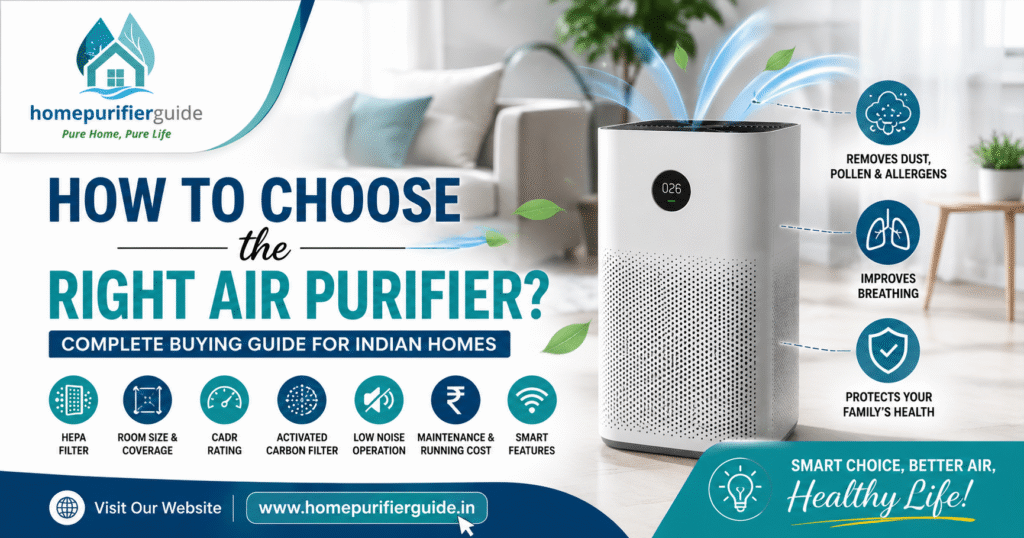
How to Choose the Right Air Purifier? Complete Buying Guide
Buying an air purifier is a smart investment for your family’s health.
But with hundreds of models available in India, choosing the right one can feel confusing.
Some purifiers are designed for small bedrooms, while others work better for large living rooms. Some focus on removing dust and pollen, while others are better for smoke and odors.
So, how do you choose the right air purifier?
This complete guide will help you understand everything in simple words.
Whether you live in Delhi, Mumbai, Bengaluru, Hyderabad, or any other city, these tips will help you make the right decision.
Why Do You Need an Air Purifier?
Indoor air pollution is becoming a serious problem.
Common indoor pollutants include:
- Dust
- PM2.5 particles
- Smoke
- Pet dander
- Pollen
- Mold spores
- Cooking odors
- VOC gases
An air purifier helps remove these harmful particles and improves indoor air quality.
It can be especially helpful for:
Allergy Patients
Air purifiers reduce pollen, dust mites, and allergens.
Asthma Patients
HEPA filters capture tiny particles that can trigger asthma attacks.
Families with Kids
Children breathe faster and are more sensitive to pollution.
Pet Owners
Purifiers help remove pet hair and dander from indoor air.
Step 1: Check Your Room Size
The first thing to consider is room size.
Many people make the mistake of buying a small purifier for a large room.
Always check the coverage area.
Recommended Room Sizes
Room Type | Ideal Coverage |
Small Bedroom | Up to 200 sq ft |
Medium Room | 200–400 sq ft |
Large Living Room | 400–700 sq ft |
A purifier with higher coverage cleans the air faster.
Step 2: Understand CADR Ratings
CADR means Clean Air Delivery Rate.
It tells you how quickly an air purifier can clean the air.
The higher the CADR, the better the performance.
General CADR Recommendations
- Small rooms: 150–200 m³/h
- Medium rooms: 250–350 m³/h
- Large rooms: 400+ m³/h
If you live in highly polluted cities like Delhi or Noida, choose a higher CADR.
Step 3: Choose a True HEPA Filter
A HEPA filter is the most important part of an air purifier.
True HEPA filters capture 99.97% of particles as small as 0.3 microns.
These include:
- Dust
- Pollen
- Pet dander
- Smoke particles
- PM2.5 pollutants
Why HEPA Filters Matter
Without a genuine HEPA filter, an air purifier cannot effectively remove harmful airborne particles.
Always look for:
✔ True HEPA Filter
Avoid marketing terms like:
❌ HEPA-Type
❌ HEPA-Like
Step 4: Check for an Activated Carbon Filter
HEPA filters remove particles.
But odors and harmful gases require something else.
That’s where activated carbon filters help.
They remove:
- Cooking smells
- Cigarette smoke
- Chemical odors
- VOC gases
- Pet smells
If you live near busy roads or industrial areas, a carbon filter is extremely useful.
Step 5: Consider Noise Levels
Nobody wants a noisy machine running all night.
Check the noise level before buying.
Recommended Noise Levels
Usage | Ideal Noise Level |
Bedroom | Below 30 dB |
Living Room | Below 50 dB |
Office | Below 45 dB |
Many modern air purifiers have sleep mode for silent operation.
Step 6: Look at Filter Replacement Costs
Many buyers focus only on the initial price.
But long-term maintenance matters too.
Before purchasing, check:
Filter Availability
Are replacement filters easily available in India?
Filter Life
Typical lifespan:
- HEPA Filter: 6–12 months
- Carbon Filter: 3–6 months
- Pre-filter: Washable every few weeks
Annual Maintenance Cost
Always calculate yearly expenses before making your final decision.
Step 7: Decide Whether You Need Smart Features
Modern air purifiers include smart technology.
Popular features include:
Air Quality Sensors
These automatically adjust fan speed based on pollution levels.
Mobile App Control
You can control the purifier using your smartphone.
Voice Assistant Support
Some models work with:
- Alexa
- Google Assistant
Smart features add convenience but are not mandatory.
Step 8: Choose Energy-Efficient Models
An air purifier runs for many hours every day.
Electricity consumption matters.
Choose models with:
- Energy-saving motors
- Auto mode
- Sleep mode
- Energy Star ratings
This helps reduce electricity bills.
Best Air Purifier Types for Different Needs
H3: Best for Allergies
Choose:
- True HEPA filter
- High CADR
- Quiet operation
Best for Asthma
Look for:
- HEPA + Activated Carbon filters
- Low ozone emissions
- Silent sleep mode
Best for Delhi Pollution
Recommended features:
- High CADR
- Multi-stage filtration
- PM2.5 monitoring
- Easy filter replacement
Best for Pet Owners
Choose models with:
- Strong HEPA filters
- Carbon filters
- Washable pre-filters
Common Mistakes to Avoid
Many people buy the wrong purifier because of simple mistakes.
Buying Without Checking Room Size
A small purifier cannot clean a large room effectively.
Ignoring Filter Costs
Cheap machines sometimes have expensive replacement filters.
Falling for Marketing Tricks
Always choose True HEPA filters.
Placing the Purifier in Corners
Keep it in open spaces for better airflow.
Air Purifier Buying Checklist
Before buying, make sure your purifier has:
✅ True HEPA Filter
✅ Activated Carbon Filter
✅ Suitable Room Coverage
✅ Good CADR Rating
✅ Affordable Filter Replacement
✅ Low Noise Operation
✅ Energy Efficiency
✅ Reliable Brand Support
Final Thoughts
Choosing the right air purifier doesn’t have to be complicated.
Focus on the basics:
- Room size
- HEPA filtration
- CADR rating
- Maintenance cost
- Noise level
A good air purifier can improve indoor air quality, reduce allergies, and help your family breathe cleaner air every day.
Take your time, compare features, and invest in a purifier that matches your needs.
Clean air is one of the best investments you can make for your health.
FAQs
Which air purifier is best for Indian homes?
The best purifier depends on your room size, pollution levels, and budget. Always choose a model with a True HEPA filter.
Is CADR important when buying an air purifier?
Yes. CADR determines how quickly the purifier can clean the air.
How often should I replace air purifier filters?
HEPA filters usually last 6–12 months, while carbon filters need replacement every 3–6 months.
Can air purifiers remove PM2.5 particles?
Yes. True HEPA filters are highly effective at removing PM2.5 pollution.