
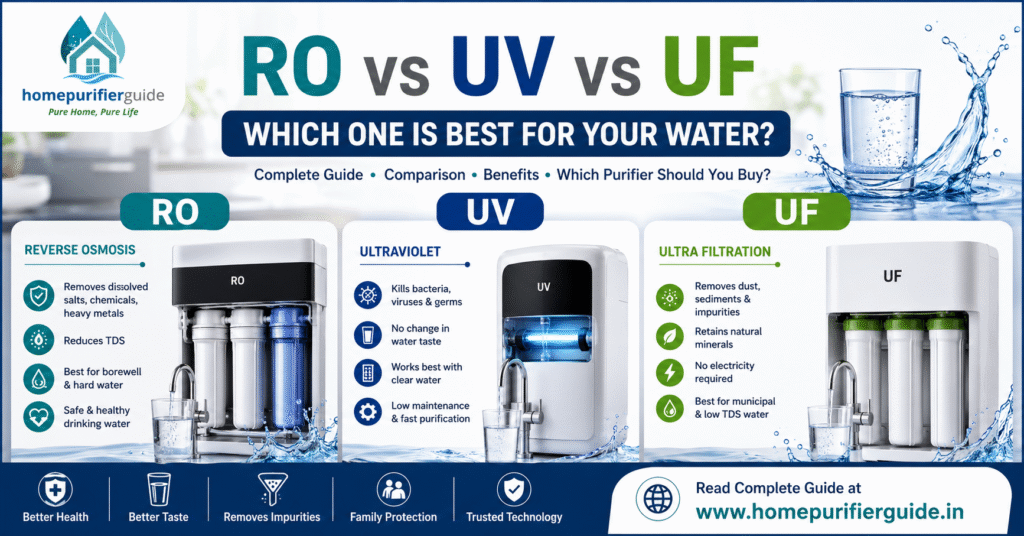
RO vs UV vs UF Water Purifier – Which One is Best in India?
Choosing the right water purifier is one of the most important decisions for every family. With increasing concerns about water pollution, harmful bacteria, dissolved chemicals, and hard water, a good water purifier has become a necessity rather than a luxury.
However, when you start looking for a water purifier online or in a store, you’ll often come across three common technologies—RO, UV, and UF. Many people get confused because all three claim to provide safe drinking water. The question is, which one is actually the best for your home?
The answer is simple: there is no single purifier that is best for everyone. The right choice depends on your water source, TDS level, and the type of impurities present in your water.
In this guide, we’ll explain the difference between RO, UV, and UF water purifiers in simple language. By the end of this article, you’ll know which purifier is the right choice for your home and avoid spending money on the wrong product.
Why Understanding Water Purification Technology is Important
Many buyers purchase a water purifier based on advertisements or brand popularity. While a trusted brand is important, the purification technology matters even more.
For example, if your home receives borewell water with high TDS, a UV purifier alone won’t solve the problem. Similarly, if your municipal water already has a low TDS level, buying an expensive RO purifier may not be necessary.
Understanding the basics of RO, UV, and UF helps you make a smarter decision and ensures your family gets clean, safe, and healthy drinking water.
What is an RO Water Purifier?
RO stands for Reverse Osmosis, one of the most widely used water purification technologies in India.
An RO purifier forces water through a semi-permeable membrane. This membrane blocks harmful contaminants while allowing purified water to pass through.
RO technology is specially designed to reduce:
- High TDS (Total Dissolved Solids)
- Excess salts
- Heavy metals
- Arsenic
- Fluoride
- Nitrates
- Harmful chemicals
- Some microorganisms
This makes RO purifiers an excellent choice for homes that receive borewell water or hard water.
Advantages of RO Water Purifier
- Reduces high TDS effectively.
- Improves the taste of salty water.
- Removes dissolved impurities.
- Suitable for hard water.
- Ideal for borewell and tanker water.
Limitations of RO
RO is not always the best option for every household.
If your water already has a low TDS level, using an RO purifier may not be necessary. It also requires electricity to operate and needs periodic filter replacement to maintain performance.
What is a UV Water Purifier?
UV stands for Ultraviolet Water Purification.
Unlike RO technology, UV purification does not remove dissolved salts or minerals. Instead, it uses ultraviolet light to deactivate bacteria, viruses, and other disease-causing microorganisms.
The UV lamp damages the DNA of harmful germs, making them unable to multiply and cause infections.
Because it doesn’t change the mineral content of the water, the natural taste remains almost the same.
Advantages of UV Water Purifier
- Kills bacteria and viruses.
- Maintains natural minerals.
- Fast purification process.
- Low maintenance.
- Suitable for treated municipal water.
Limitations of UV
UV technology cannot remove:
- High TDS
- Heavy metals
- Dissolved salts
- Mud
- Sand
- Rust particles
If your water contains these impurities, UV alone is not enough.
What is a UF Water Purifier?
UF stands for Ultrafiltration.
A UF purifier uses a hollow fiber membrane with tiny pores to remove suspended particles, dirt, cysts, and many microorganisms from water.
Unlike RO, UF does not reduce TDS. However, one major advantage is that it works without electricity.
This makes UF purifiers a practical choice for areas with frequent power cuts.
Advantages of UF Water Purifier
- No electricity required.
- Removes suspended particles.
- Filters bacteria and cysts.
- Low maintenance.
- Affordable compared to many electric purifiers.
Limitations of UF
A UF purifier cannot remove:
- Dissolved salts
- Heavy metals
- High TDS
- Chemical contaminants
Therefore, it is suitable only when the water already has a low TDS level.
RO vs UV vs UF – Understanding the Key Differences
Although all three technologies are designed to improve drinking water quality, they work in completely different ways.
The biggest difference lies in what each technology removes.
|
Feature |
RO |
UV |
UF |
|
Removes High TDS |
✅ Yes |
❌ No |
❌ No |
|
Removes Bacteria |
✅ Yes |
✅ Yes |
✅ Yes (many) |
|
Removes Viruses |
✅ Yes |
✅ Yes |
Limited |
|
Removes Heavy Metals |
✅ Yes |
❌ No |
❌ No |
|
Removes Mud & Dust |
✅ Yes |
❌ No |
✅ Yes |
|
Needs Electricity |
✅ Yes |
✅ Yes |
❌ No |
|
Suitable for Borewell Water |
✅ Yes |
❌ No |
❌ No |
|
Suitable for Municipal Water |
Sometimes |
✅ Yes |
✅ Yes |
|
Best for Hard Water |
✅ Yes |
❌ No |
❌ No |
From this comparison, it’s clear that each technology serves a different purpose.
- RO focuses on removing dissolved impurities and reducing high TDS.
- UV protects against bacteria and viruses but does not remove dissolved salts.
- UF filters suspended particles and many microorganisms without using electricity.
This is why many modern water purifiers combine RO + UV + UF technologies. Such multi-stage purification systems provide comprehensive protection by addressing different types of contaminants in a single unit.
However, choosing a combined purifier is only beneficial if it matches your water quality. Buying a purifier with features you don’t actually need can increase both the purchase price and maintenance costs.
In the next part, we’ll compare RO vs UV vs UF in real-life situations, discuss which purifier is best for municipal water, borewell water, tanker water, and apartments in India, explore common buying mistakes, and help you decide which option offers the best value for your family.
RO vs UV vs UF Water Purifier: Which One Should You Choose?
Now that you understand how RO, UV, and UF purification technologies work, the next step is choosing the one that matches your home’s water quality. Buying the right purifier isn’t about selecting the most expensive model—it’s about choosing the technology that solves your water problems.
Let’s compare these purification methods in real-life situations.
RO vs UV vs UF: Detailed Comparison
Every water purifier has its own strengths and limitations. Here’s a simple comparison to help you understand which technology is best for different needs.
RO Water Purifier – Pros & Cons
Pros
- Removes high TDS effectively.
- Eliminates dissolved salts and harmful chemicals.
- Reduces heavy metals like arsenic and lead.
- Improves the taste of hard or salty water.
- Best choice for borewell and hard water.
Cons
- Requires electricity.
- Needs regular filter replacement.
- May not be necessary for low TDS municipal water.
- Generally costs more than basic UV or UF models.
Best for: Homes with borewell water, tanker water, or water containing high TDS.
UV Water Purifier – Pros & Cons
Pros
- Kills bacteria and viruses efficiently.
- Retains natural minerals in water.
- Quick purification process.
- Lower maintenance compared to many RO systems.
- Suitable for treated municipal water.
Cons
- Cannot reduce TDS.
- Does not remove heavy metals.
- Cannot filter mud, sand, or visible particles.
Best for: Homes receiving treated municipal water with low TDS.
UF Water Purifier – Pros & Cons
Pros
- Works without electricity.
- Removes suspended particles and many microorganisms.
- Easy to maintain.
- Budget-friendly.
- Ideal for areas with frequent power cuts.
Cons
- Does not remove dissolved salts.
- Cannot reduce TDS.
- Not suitable for hard water.
Best for: Areas where water already has a low TDS level but may contain dust or suspended particles.
Which Water Purifier is Best for Different Water Sources?
One of the most common questions buyers ask is, “Which purifier should I buy for my home?”
The answer depends on your water source.
Municipal Water Supply
Most city water supplied by local municipal authorities is already treated before reaching homes. However, old pipelines can sometimes introduce bacteria or other contaminants.
If your municipal water has a low TDS level, a UV purifier or UV + UF purifier is usually a suitable choice.
Borewell Water
Borewell water often contains:
- High TDS
- Excess minerals
- Hardness
- Fluoride
- Dissolved salts
In such cases, an RO water purifier is generally the most effective option.
Many Indian households using borewell water prefer RO + UV + UF purifiers for more comprehensive purification.
Tanker Water
The quality of tanker water can vary from one supplier to another.
Since it may contain both dissolved impurities and microorganisms, a multi-stage purifier with RO, UV, and UF technologies is often a practical choice.
Well Water
Well water quality depends on location and seasonal changes.
Before buying a purifier, it’s a good idea to test the water.
If the TDS is high, choose an RO purifier.
If the TDS is low but bacterial contamination is a concern, UV or UF may be enough.
Do You Need an RO + UV + UF Water Purifier?
Many premium water purifiers combine all three purification technologies.
These models offer several benefits.
- Better protection against multiple contaminants.
- Suitable for changing water quality.
- Improved taste.
- Multiple purification stages.
- Peace of mind for families.
However, more technology doesn’t always mean a better choice.
If your home’s water quality doesn’t require RO purification, buying a combined system may increase your maintenance costs unnecessarily.
Always choose a purifier based on your water quality rather than marketing claims.
Tips Before Buying a Water Purifier
Keep these practical tips in mind before making your purchase.
- Test your water’s TDS level.
- Identify whether your water comes from a municipal supply, borewell, or tanker.
- Compare annual maintenance costs.
- Check filter replacement prices.
- Ensure the brand has good after-sales service in your city.
- Buy from a trusted seller.
- Look for warranty coverage and genuine spare parts.
These simple checks can help you avoid unexpected expenses later.
Frequently Asked Questions
Which water purifier is best in India?
There is no single purifier that’s best for everyone. The right choice depends on your water source and TDS level.
Is an RO purifier better than a UV purifier?
RO is better for high TDS water because it removes dissolved salts and heavy metals. UV is better suited for treated water with low TDS where the main concern is bacteria and viruses.
Can I use a UV purifier for borewell water?
Generally, no. Borewell water often has high TDS, which UV technology cannot reduce.
Does a UF purifier need electricity?
No. UF water purifiers usually work without electricity.
Which purifier is best for a family of four?
The answer depends on your water quality. Many families with high TDS water choose RO or RO + UV + UF models, while families with treated municipal water may find a UV purifier sufficient.
Final Verdict
Choosing between RO, UV, and UF doesn’t have to be confusing.
Each technology has a specific purpose.
- Choose RO if your home receives borewell or hard water with high TDS.
- Choose UV if your municipal water has low TDS but you want protection against bacteria and viruses.
- Choose UF if your water has low TDS, contains suspended particles, and you need a purifier that works without electricity.
If you’re unsure about your water quality, start by checking the TDS level or getting your water tested. A simple test can help you choose the right purifier and avoid spending money on features you don’t actually need.
The best water purifier isn’t the one with the longest feature list—it’s the one that’s designed for your home’s water conditions.
At HomePurifierGuide.in, we help you make informed decisions with honest reviews, detailed comparisons, and easy-to-understand buying guides. Explore our latest recommendations to find the best water purifier for your home and enjoy safe, clean drinking water every day.