
Ionizer vs HEPA – What’s Safe for Home? Complete Comparison Guide (2026)
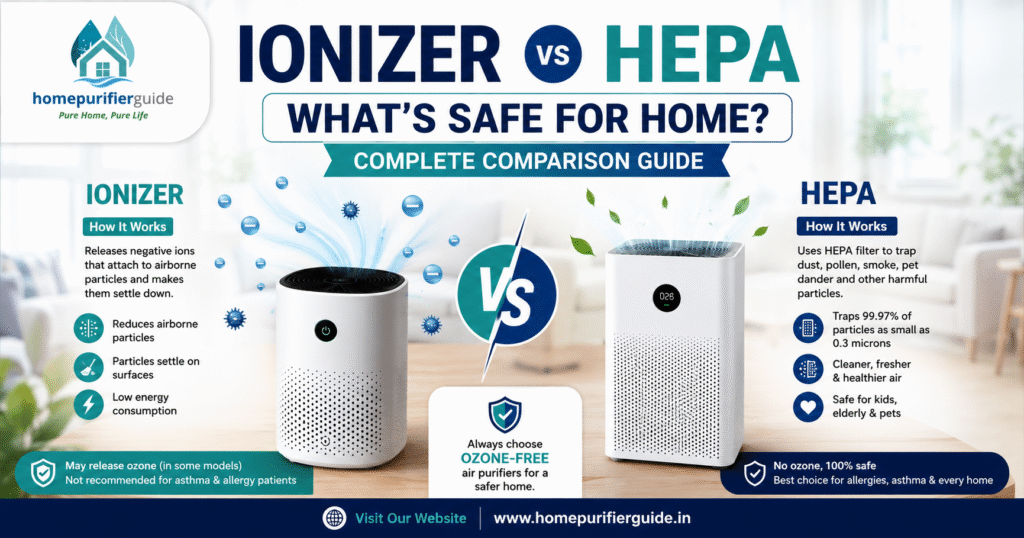
Ionizer vs HEPA – What’s Safe for Home?
Buying an air purifier sounds easy until you start comparing technologies.
One of the biggest questions people ask is:
Should I buy a HEPA air purifier or an Ionizer?
Both promise cleaner air.
Both remove pollutants.
But they work in completely different ways.
More importantly, one technology is usually safer for everyday home use.
If you have children, elderly family members, asthma, allergies, or pets, choosing the right purifier becomes even more important.
This complete guide explains everything in simple language.
By the end, you’ll know exactly which air purifier is best for your home.
Why Choosing the Right Air Purifier Matters
Indoor air often contains:
- Dust
- PM2.5 particles
- Smoke
- Pet dander
- Pollen
- Mold spores
- Cooking fumes
- Harmful allergens
These pollutants may cause:
- Sneezing
- Asthma attacks
- Allergies
- Eye irritation
- Sinus problems
- Poor sleep
- Breathing difficulties
A good air purifier removes these particles before they affect your health.
But not every technology works the same.
What is a HEPA Air Purifier?
HEPA stands for High-Efficiency Particulate Air.
A HEPA filter captures extremely tiny airborne particles.
It works like a very fine mesh.
Dirty air passes through the filter.
Clean air comes out.
Nothing harmful is released back into the room.
HEPA Filters Remove
✔ Dust
✔ PM2.5
✔ Pollen
✔ Pet Hair
✔ Pet Dander
✔ Mold Spores
✔ Smoke Particles
✔ Allergens
✔ Fine Dust
This is why HEPA technology is recommended for homes.
What is an Ionizer Air Purifier?
Ionizers work differently.
Instead of trapping dust inside a filter,
they release negative ions into the air.
These ions attach to airborne particles.
The particles become heavier.
Eventually they fall onto:
- Floors
- Furniture
- Curtains
- Tables
Some ionizers also use collection plates.
Others simply allow dust to settle around the room.
How Does an Ionizer Work?
Imagine tiny magnets.
Negative ions attach themselves to dust.
The dust becomes heavy.
Instead of floating in the air,
it settles onto nearby surfaces.
You still need regular cleaning because the dust remains inside your home.
HEPA vs Ionizer – Quick Comparison
| Feature | HEPA | Ionizer |
| Removes Dust | ✅ Yes | ⚠ Partially |
| Removes Allergens | ✅ Excellent | Moderate |
| Removes Smoke | ✅ Yes | Limited |
| Traps Pollutants | ✅ Yes | No |
| Releases Ozone | ❌ No | Some models may |
| Safe for Children | ✅ Yes | Depends on model |
| Good for Asthma | ⭐ Excellent | Not Recommended |
| Maintenance | Replace Filter | Clean Plates |
| Best for Home | ⭐⭐⭐⭐⭐ | ⭐⭐⭐ |
Which One Cleans Air Better?
HEPA wins.
Why?
Because it physically traps pollutants inside the filter.
Dust cannot return into the room.
Ionizers simply move particles out of the air.
The particles may later become airborne again while cleaning or walking.
Is an Ionizer Safe?
This is the biggest concern.
Some ionizers produce ozone as a by-product.
Ozone is useful high in the atmosphere.
Inside homes, it can irritate:
- Nose
- Eyes
- Lungs
- Throat
People with asthma may feel more discomfort.
Children and older adults may also be more sensitive.
If you buy an ionizer, choose one specifically labeled ozone-free or low ozone.
Why Most Experts Recommend HEPA
Medical professionals often recommend HEPA filtration because it:
- Doesn’t produce ozone
- Removes allergens effectively
- Improves indoor air quality
- Works well for asthma
- Helps reduce allergy symptoms
Many hospitals, clinics, and healthcare facilities also use HEPA filtration systems.
Best Choice for Allergy Sufferers
If you have:
- Dust allergy
- Pollen allergy
- Pet allergy
- Sinus issues
Choose a HEPA purifier.
It removes the particles causing the problem.
Best Choice for Asthma Patients
Asthma patients should generally avoid unnecessary ozone exposure.
HEPA air purifiers are the safer option.
They clean the air without releasing additional gases.
What About Pet Owners?
Homes with pets contain:
- Hair
- Dander
- Dust
- Odors
The ideal solution is:
✔ True HEPA Filter
- Activated Carbon Filter
This combination removes both particles and odors.
Energy Consumption
Both technologies consume relatively little electricity.
However,
modern HEPA air purifiers include:
- Auto Mode
- Sleep Mode
- Energy Saving Mode
making them efficient for daily use.
Maintenance Comparison
HEPA
- Replace filter every 6–12 months
- Clean pre-filter monthly
Simple maintenance.
Ionizer
- Clean collection plates regularly
- Wipe nearby furniture frequently
- Remove settled dust
Requires more room cleaning.
Who Should Buy a HEPA Air Purifier?
Choose HEPA if you have:
✔ Kids
✔ Babies
✔ Senior citizens
✔ Asthma
✔ Allergies
✔ Pets
✔ High pollution area
✔ Bedroom use
✔ Daily indoor use
Who Can Buy an Ionizer?
An ionizer may be suitable if:
- You want less floating dust
- Your model is certified ozone-free
- You don’t have respiratory conditions
- You’re willing to clean settled dust often
Common Buying Mistakes
Many buyers make these mistakes:
❌ Buying only by price
❌ Ignoring filter replacement cost
❌ Buying without checking room size
❌ Choosing ionizers without researching ozone
❌ Ignoring CADR rating
Always compare performance—not just features.
Final Verdict
If your priority is health, safety, and cleaner indoor air, a True HEPA air purifier is the better choice.
It captures dust, pollen, pet dander, smoke, and fine particles without releasing ozone, making it ideal for families, children, allergy sufferers, and asthma patients.
Ionizers can reduce airborne particles, but because some models may produce ozone and allow dust to settle on surfaces instead of trapping it, they are generally less suitable for everyday home use.
For most Indian homes, especially in cities with high pollution, a True HEPA air purifier with an activated carbon filter offers the best balance of performance, safety, and long-term value.
Frequently Asked Questions
Which is better, HEPA or Ionizer?
For most homes, HEPA is the better option because it traps airborne particles without producing ozone.
Do ionizers remove dust?
They help particles settle onto surfaces but do not trap them inside a filter.
Can an ionizer trigger asthma?
Some ozone-producing ionizers may irritate the lungs of people with asthma or other respiratory conditions.
Which air purifier is best for Indian homes? A True HEPA air purifier with an activated carbon filter is suitable for removing dust, smoke, allergens, and odors commonly found in Indian homes.