
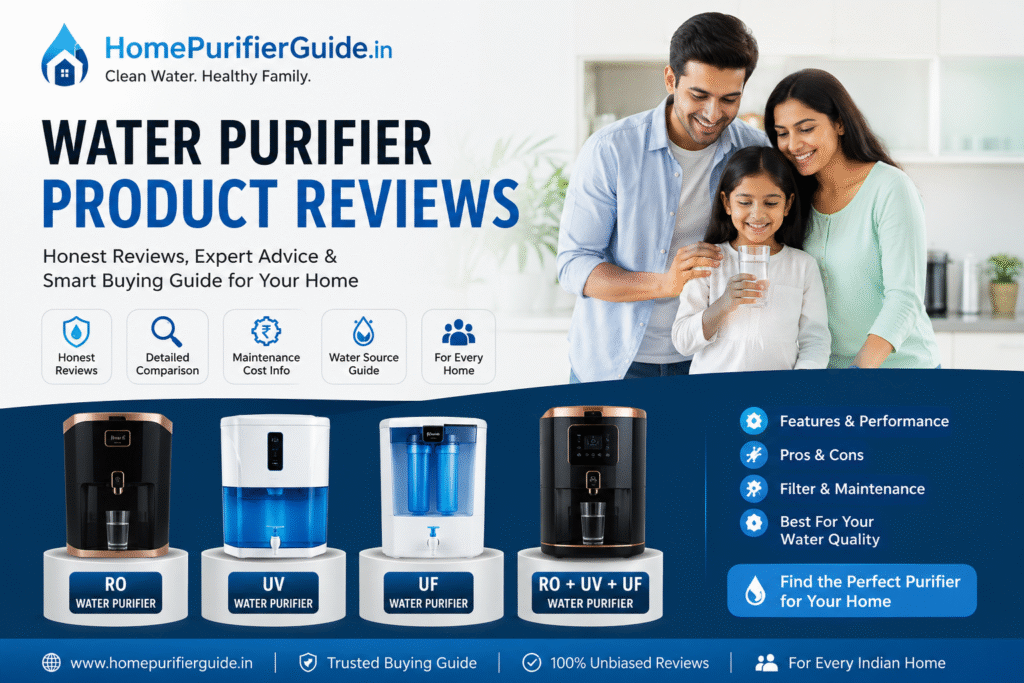
Water Purifier Product Reviews
Choosing a water purifier is not always easy. There are many brands, models, purification technologies, and features available today. RO, UV, UF, alkaline, mineral enhancers, multiple filters—the options can quickly become confusing.
This is where a good water purifier review can help.
At Home Purifier Guide, we look at water purifiers from a practical point of view. Instead of focusing only on marketing claims, our reviews help you understand the important things before you buy.
We cover features, purification technology, water-source suitability, maintenance, filter replacement, storage capacity, advantages, limitations, and overall value.
Whether you are looking for an RO water purifier for borewell water, a UV purifier for municipal water, or an affordable purifier for your family, our product reviews are designed to make your decision easier.
What We Check in Our Water Purifier Reviews
A water purifier is a long-term household purchase. The purchase price is only one part of the total cost.
When evaluating a purifier, there are several things worth checking.
Purification Technology
The first thing we look at is the purification technology used by the product.
Depending on the model, a purifier may use:
- RO
- UV
- UF
- Sediment filtration
- Activated carbon filtration
- Mineral enhancement
- TDS control
- Multiple purification stages
Different technologies solve different water-quality problems. For example, RO is useful for reducing many dissolved substances, while UV is designed to deactivate microorganisms.
The right technology depends on your water source and quality.
Water Source Compatibility
Not every purifier is suitable for every home.
Your water may come from:
- Municipal supply
- Borewell
- Tanker
- Well
- Mixed water supply
A good review should explain what type of water the purifier is designed to handle.
For example, a household using high-TDS borewell water may have different requirements from an apartment receiving treated municipal water.
TDS and Water Quality
TDS, or Total Dissolved Solids, is another important consideration when choosing an RO purifier.
A high TDS level can indicate a significant amount of dissolved salts and minerals in the water. However, TDS alone does not tell you everything about water safety.
That is why our reviews focus on the bigger picture instead of recommending a purifier based only on one number.
Filter Replacement and Maintenance
Many buyers look at the purifier’s purchase price but forget about maintenance.
Filters eventually need replacement, and the cost can vary significantly between models.
Our reviews encourage buyers to consider:
- Filter replacement frequency
- Approximate maintenance requirements
- Availability of replacement filters
- Service support
- Long-term running cost
This can help you avoid choosing a purifier that looks affordable initially but becomes expensive to maintain.
Our Water Purifier Review Approach
A useful product review should answer one simple question:
Is this purifier suitable for your home?
We don’t believe there is one perfect purifier for everyone.
Instead, we look at the product from the buyer’s perspective.
Features
We explain the main features in simple language rather than filling the review with technical specifications.
Performance
Where reliable information or hands-on experience is available, we consider how the purifier performs in everyday use.
Pros and Cons
Every product has strengths and limitations.
We clearly discuss both so readers can make a balanced decision.
Maintenance
We consider filter replacement, servicing, installation, and other ongoing requirements.
Value for Money
A higher-priced purifier isn’t automatically better.
We consider whether the features and performance justify the overall cost for the intended user.
Types of Water Purifiers We Review
RO Water Purifiers
RO, or Reverse Osmosis, is widely used for homes where water contains high levels of dissolved solids.
RO systems can reduce many dissolved contaminants and are commonly considered for borewell and other high-TDS water sources.
Our RO purifier reviews focus on purification stages, water suitability, storage, maintenance, filter costs, and useful features.
UV Water Purifiers
UV purification uses ultraviolet light to deactivate microorganisms.
UV systems are often considered for treated water supplies where dissolved solids are not the main concern.
Our UV purifier reviews explain where UV technology makes sense and where additional filtration may be required.
UF Water Purifiers
UF, or Ultrafiltration, uses a membrane to filter suspended particles and certain microorganisms.
One advantage of many UF systems is that they can operate without electricity.
Our reviews explain when UF can be a practical choice and its limitations compared with RO and UV systems.
RO + UV + UF Purifiers
Some modern water purifiers combine several technologies.
These systems are designed to provide multiple stages of purification and may be useful when water quality is more complicated.
However, more purification stages do not automatically mean a product is better for every home.
Our reviews help you understand whether the combination is actually useful for your water source.
What Should You Check Before Buying a Water Purifier?
Before purchasing any purifier, consider these questions.
1. What is your water source?
Know whether you receive municipal, borewell, tanker, or another type of water.
2. What is your water quality?
If possible, test your water and check its TDS level. For more serious concerns, a proper water-quality test can provide more useful information than TDS alone.
3. How many people are in your family?
A larger family may need a purifier with a larger storage tank and suitable purification capacity.
4. What is the maintenance cost?
Check filter replacement and servicing costs before buying.
5. Is service available in your area?
A purifier is easier to own when replacement parts and authorized service are readily available.
6. Do you need RO?
Don’t buy RO simply because it is popular.
If your water does not require RO treatment, another purification technology may be more appropriate.
Water Purifier Reviews vs Manufacturer Specifications
Manufacturer specifications are useful, but they are only one part of the buying decision.
A product page may tell you the storage capacity, number of purification stages, filter type, and other specifications.
A useful review should go further.
It should explain what those specifications mean for an actual household.
For example, knowing that a purifier has multiple purification stages is useful. But the more important question is whether those stages are appropriate for your home’s water quality.
That’s the type of practical information we aim to provide.
Who Can Benefit From Our Reviews?
Our water purifier reviews are useful for:
- Families buying their first purifier
- Apartment owners
- People using borewell water
- Homes using tanker water
- Users comparing RO and UV
- Buyers looking for affordable purifiers
- Families comparing different brands
- People planning to replace an old purifier
- Buyers checking maintenance costs before purchase
Our Goal
The purpose of Home Purifier Guide is simple: help people make better water purifier decisions.
We want readers to understand what they are buying rather than choosing a product only because of an advertisement, discount, or popular brand name.
A good purifier should match your water quality, household needs, budget, and maintenance expectations.
That’s why our product reviews focus on useful information that can help you compare products before spending your money.
Final Thoughts
Finding the right water purifier takes more than comparing prices.
Your water source, TDS level, purification technology, family size, storage capacity, maintenance requirements, and local service availability all matter.
Use our water purifier product reviews as a starting point, compare the options carefully, and always consider your home’s actual water quality before making a final decision.
The best water purifier isn’t necessarily the most expensive model.
It’s the one that fits your water and your household needs.